
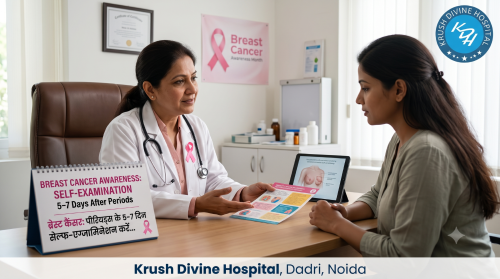
Breast cancer remains a critical health challenge for women worldwide, and unfortunately, a majority of cases are diagnosed at an advanced stage. According to GloBocan 2024 estimates, India will see approximately 2.37 lakh new breast cancer cases this year, leading to nearly 96,100 deaths.
Despite these alarming numbers, awareness remains low. A 2016 study in Delhi revealed that fear, hesitation, and a tendency to deprioritize personal health prevent many women from seeking timely medical advice. Furthermore, a 2025 study published in Uttar Pradesh showed that only 37.7% of women knew the correct method for breast self-examination, and a mere 29.7% performed it regularly.
At Krush Divine Hospital, we believe that early detection is your strongest defense. This Breast Cancer Awareness Month, we want to empower you with the knowledge to perform regular self-examinations and break the stigma surrounding breast health.
The “Golden Window” for Self-Examination
When is the right time to check? Medical experts strongly recommend performing a self-examination 5 to 7 days after your period ends every month.
Why this specific time? During this period, the hormonal fluctuations in your body decrease, making the breast tissue relatively softer and less tender. This makes it significantly easier to feel any unusual lumps, bumps, or structural changes.
How to Perform a Self-Examination
Keep a close watch on any physical changes.
- Visual Inspection: Stand in front of a mirror and observe the shape, skin texture, and nipples for any visible alterations.
- Physical Check: Using a gentle touch, feel the tissue around your breasts, under your armpits (axilla), and around your collarbone.
The goal is not to self-diagnose but to understand what is normal for your body so you can quickly identify any unusual changes.
8 Crucial Questions Women Hesitate to Ask (Answered)
Hesitation can delay life-saving treatment. Here are the facts behind common breast cancer myths and concerns:
1. Is every breast lump cancerous? No. A lump in the breast is not always cancer; it can be a benign (non-cancerous) tumor or cyst. However, you cannot determine this just by touching it. Imaging tests like an ultrasound or mammography, and sometimes a biopsy, are necessary to clarify the nature of the lump. (Note: A biopsy is a completely safe procedure and does not cause the lump to spread).
2. If there is a family history, when should screening start? If you have a family history of breast or ovarian cancer occurring at a young age, genetic counseling should be considered. In such cases, additional screening tools like mammography or a Breast MRI might be required even at a younger age, based on your doctor’s assessment of your genetic and familial risk.
3. Does breast pain mean I have cancer? Usually, no. There can be many reasons for breast pain, including hormonal changes, infections, or other benign conditions. Pain alone does not mean cancer. However, if the pain persists continuously, or if you notice an accompanying lump or changes in the skin or nipple, it is essential to consult a doctor immediately.
4. Can I get breast cancer if no one in my family has had it? Yes. While a family history increases the risk, the absence of a family history does not guarantee immunity. Beyond genetics, factors such as increasing age, being overweight, lack of physical activity, alcohol consumption, and other lifestyle risks significantly contribute to the likelihood of developing breast cancer.
5. When is routine screening necessary? Screening is based on age and individual risk factors. For example, the US Preventive Services Task Force recommends that women aged 40 to 74 undergo a mammography every two years. Your doctor can help determine the best screening schedule for you based on your age, family history, and personal risk factors.
6. Do early-stage cancerous lumps cause pain? Generally, early-stage breast cancer lumps do not cause pain. However, whether a lump hurts or not cannot definitively confirm or rule out cancer.
7. Can I have breast cancer even if there is no lump? Yes, it is possible. Not every breast cancer presents as a distinct lump. Sometimes, it manifests as swelling in the armpit, changes in the skin, or nipple discharge.
8. If diagnosed, will my entire breast have to be removed? Not necessarily. In many cases, only the cancerous portion is removed (a procedure known as a lumpectomy), followed by radiation therapy. Advanced surgical techniques prioritize breast conservation whenever safely possible.
Do Not Ignore the Signs – Speak to an Expert Today
At Krush Divine Hospital, located in Dadri, Noida, our dedicated oncology and women’s wellness experts are here to support you in a comfortable, judgment-free environment. Do not let fear or hesitation stop you from prioritizing your health.
If you notice any unusual changes during your monthly self-examination, or if it is time for your routine screening, book an appointment with our specialists today.
Your health is your true wealth. Protect it.
📍 Visit Us: Krush Divine Hospital, Dadri, Noida
📞 Book an Appointment: 098114 64831
🌐 Website: https://krushdivinehospital.com/

